
GEAR TALK – Epiphone Riviera CH
Boy, I love this guitar!
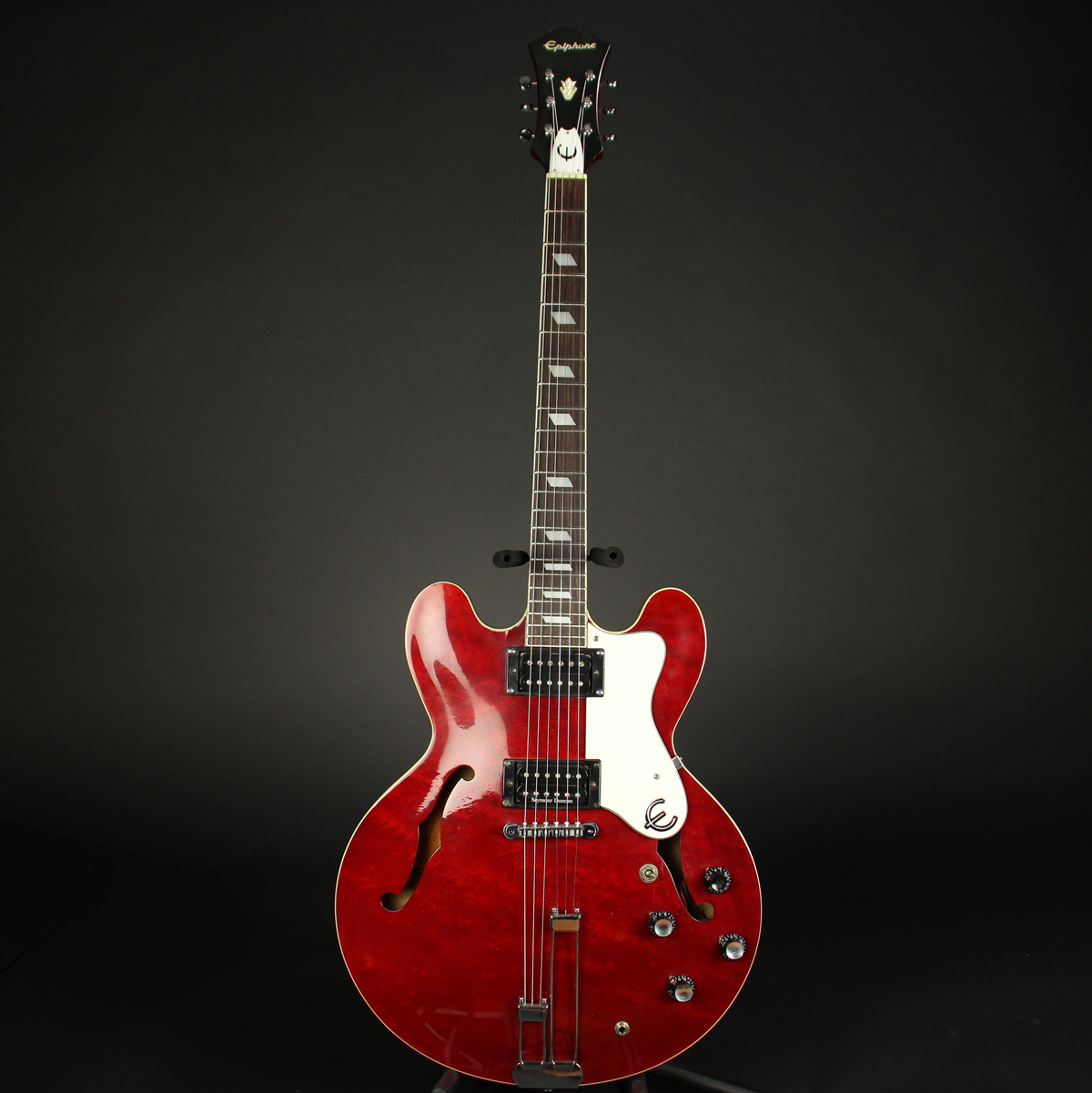
And so might you. Why, you might ask… Well, first of all, just look at it. It looks stunning. And as we all know: looks are everything! But there are a few more things I’d like to point out.
My Epiphone Riviera is a semi-hollow electric, shaped somewhat like its more expensive cousin, the Gibson ES-335. But the Riviera feels surprisingly light. That matters more than you might think. I can play it for hours without feeling as if my left shoulder is slowly separating itself from the rest of my body.
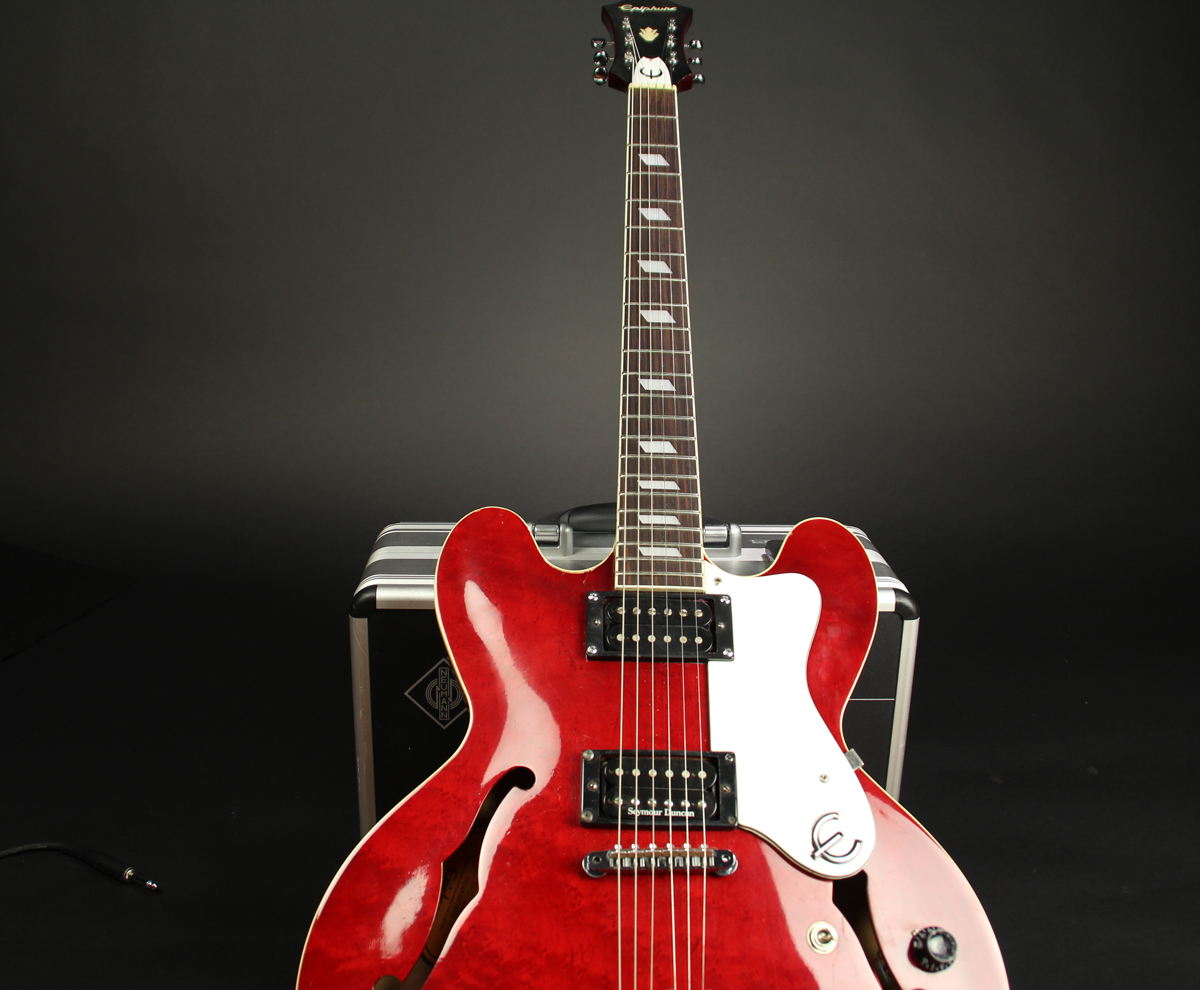
The guitar has a set mahogany neck and a rosewood fingerboard with parallelogram inlays. The 24.75-inch scale feels familiar, but the neck has always felt a little more substantial in my hands than many other electrics I’ve played. For me, that makes the transition between acoustic and electric guitar especially comfortable.
If you’re used to acoustic guitars, have slightly bigger hands, or simply like an electric that gives you something substantial to hold on to, you may love the Riviera as much as I do.
Well, maybe not quite as much.
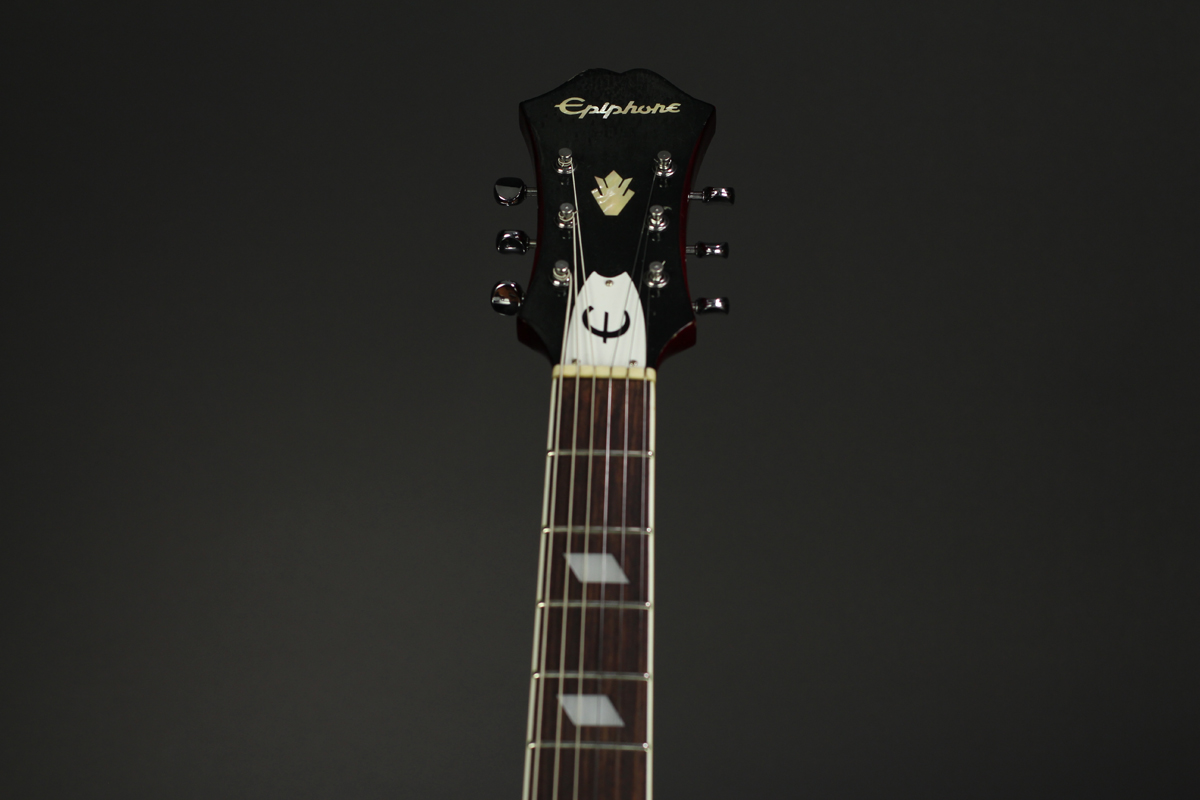
The original Epiphone Riviera was introduced in the early 1960s and built in Epiphone/Gibson’s Kalamazoo factory. Vintage examples from that period have become seriously desirable guitars.
My Riviera is from a much later era. From what I’ve been able to establish, it appears to be part of the Riviera reissue series that appeared in the 1990s.
That’s one of the things I’ve always liked about Epiphone. You can get a guitar with real history, character and personality without necessarily having to spend Gibson money.
When I originally wrote about this guitar in February 2016, a Riviera Custom P93 could be found for around $500.
That was an extraordinary amount of guitar for the money.
But enough about looks, history and price.
What does the thing actually sound like?
Pick Ups
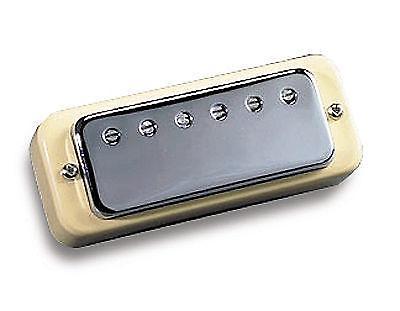
The original 1960s Riviera is particularly associated with its mini-humbuckers, which contributed to the guitar’s distinctive sound.
My Riviera, however, has been modified.
As you can see from the pictures, I replaced the pickups with a Seymour Duncan Hot Rodded Humbucker Set—the classic JB bridge and Jazz neck combination.
There’s an old argument among guitarists about single coils versus humbuckers. Very simply put: single coils tend to give you more brightness, bite and snap, while humbuckers tend to give you more body, output and thickness. I wanted something somewhere in between. The Seymour Duncans gave me exactly that.
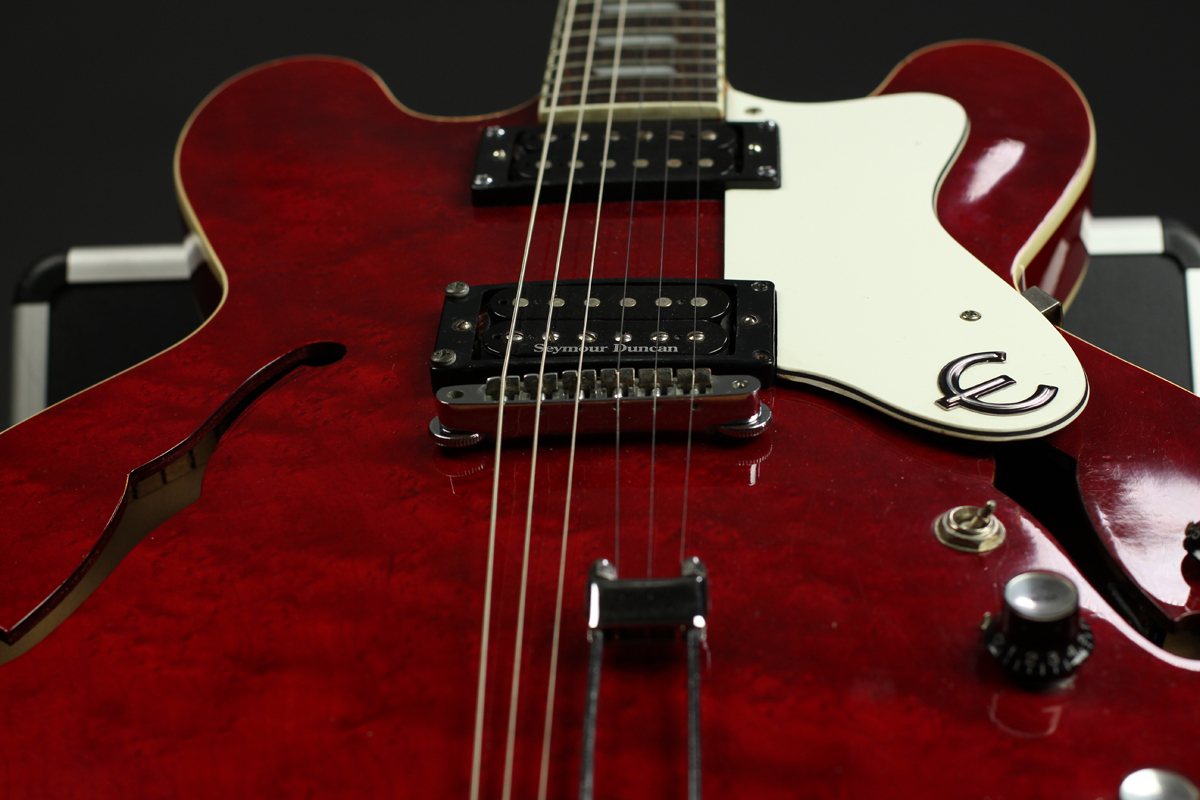
The JB in the bridge has plenty of output and can push an amp when I need it to, while the Jazz neck pickup stays articulate and clear. Together they give the Riviera a full sound without turning everything into mud.
And because they’re humbuckers, they’re also considerably quieter than traditional single coils. For the kind of music I play, that’s important. I can go from something delicate and almost acoustic-sounding to pop, rock, blues and considerably heavier territory without feeling as though I need to change guitars. I’ve played this thing in all kinds of situations. It just works.
How Epiphone got started
The Epiphone story itself is fascinating. Its roots go back to the Stathopoulo family, a Greek family of instrument makers whose story began in the Ottoman Empire in the late 19th century.
Anastasios Stathopoulos eventually brought the family and the instrument-making business to the United States, settling in New York. After his death, his son Epaminondas Stathopoulos—“Epi”—took over. The name Epiphone combined Epi’s nickname with the Greek word phonē, meaning “sound” or “voice.” Under Epi, the company became one of America’s great instrument makers and a serious competitor to Gibson, particularly in the archtop guitar market. Its Manhattan showroom attracted some of the finest musicians of the era.

Epaminondas (Epi) Stathopoulo
After Epi’s death in 1943, however, the company went through increasingly difficult times. Gibson eventually acquired Epiphone in 1957.
Over the following decades, Epiphone production moved overseas, including Japan and Korea, and later China. The company became Gibson’s more affordable sister brand—but continued producing guitars with an identity and following of their own.
And then there are the people who played them. More about that in a minute. First, I have to tell you what happened to mine.
The night my Riviera broke its neck
It was a typical Saturday night. We had finished our final set, and a few people were still hanging around after the party. Back in Norway we’d call this the nachspiel—the party after the party. My Riviera was sitting nearby. Bad idea. At some point, a couple came swaying through the room, stumbled into the monitors and landed on my guitar.
Crack.
The neck broke.
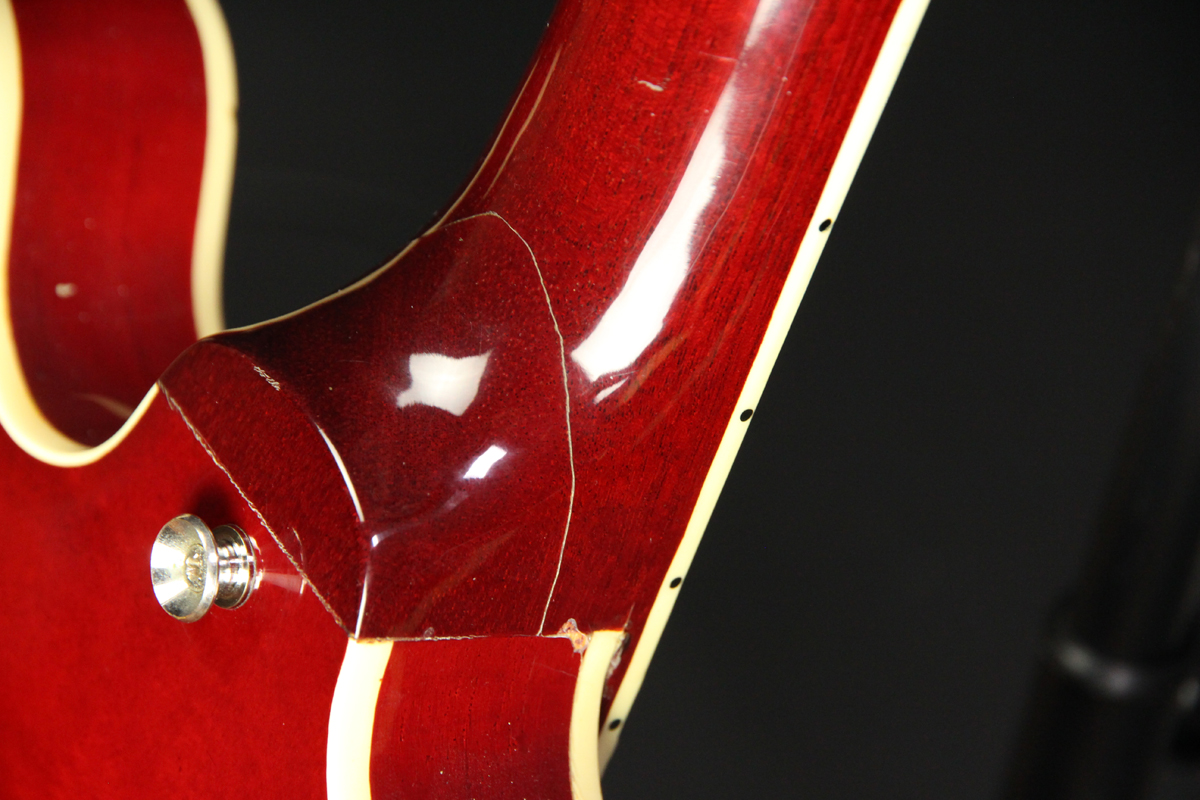
Devastation.
If you’ve ever had a guitar you truly love, you probably know the feeling. A guitar eventually stops being a piece of wood with strings attached to it. It becomes your guitar. And suddenly mine looked finished. Fortunately, I had a knowledgeable friend who thought otherwise.
He repaired it by inserting two pieces of wood to reinforce the damaged area and then carefully gluing the neck and body back together. And something very strange happened.
The guitar came back better.
It was more stable. It stayed in tune better. In fact, I can now play an entire show without having to retune it, which is pretty remarkable for a guitar that once had its neck snapped. There’s probably a metaphor in there somewhere.
Something can look completely destroyed and still come back stronger than it was before. So never write off a broken guitar. Maybe don’t let drunk people fall on it in the first place, though.
Famous players
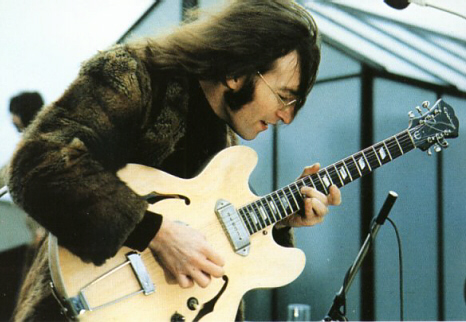
John Lennon is probably the most famous Epiphone player of all time. Of course, Lennon is one of the most famous anything in popular music, so perhaps that isn’t surprising.
His Epiphone Casino became inseparable from his image during the Beatles’ later touring years and into the band’s studio period. Paul McCartney also played a Casino, as did George Harrison.
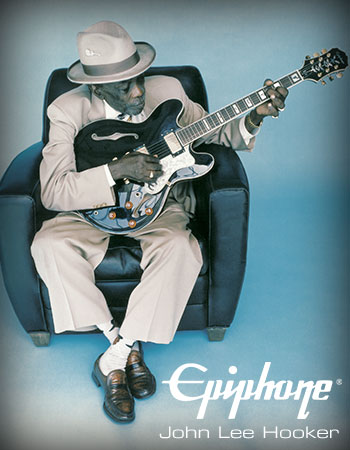
And over the years, Epiphone guitars have found their way into the hands of musicians ranging from blues legends to hard-rock players. That’s part of what I love about Epiphone. It has never felt like a guitar that needs to impress anybody with the name on the headstock.
It’s a musician’s guitar. A working guitar. A working-class hero, if you’ll forgive the Lennon reference.
And mine has the scars to prove it.


Shameless promotion
So, after all this talk, you should probably hear the Riviera in action. This performance took place at the Grand Ballroom in Manhattan in 2011. I was performing Leonard Cohen’s “Hallelujah.” The plan was simple: sing the regular verses and get through the song like a responsible professional musician. Then, somewhere along the way, this high note bubbled up.
I went for it. The audience reacted. And I promptly forgot the words to the friggin’ fourth verse.
So I improvised my way out of it. Ever since then, I’ve only sung these three verses when I perform the song. Sometimes mistakes make the arrangement.
And yes—the guitar I’m playing is the Riviera. The same guitar that got knocked over. The same guitar that had its neck broken. The same guitar that came back better than before.
And after all these years, I’m still playing it. Maybe that’s the best review I can give it.
If you’d like to hear more of my music, sign up for my email list below and I’ll send you three tracks from my album America.
And if you own an Epiphone yourself, send me a picture. I’d love to see yours.
Talk soon!
Ben
If you would like to know more about my music, please
sign up to my email list below. Sign up now and I will send you three tracks from my album “America”.
Do you own an epiphone yourself? Send me a picture!
I will feature it on my social media.
Talk soon!
Sustain the awesome job !! Lovin’ it! http://tinyurl.com/jjl3tn9
Thank you Fleurette:)
Vackra bilder! <3Jag tror att sambon hade Baten Kaitos när vi trfe¤Ãadfs, men att han sÃ¥lde det strax efter. Han gillade det aldrig och jag var väl inte sÃ¥ nyfiken pÃ¥ det heller. :SChrono Trigger har jag petat lite pÃ¥, men inte dykt in i. Jag blir väldigt sugen nu efter att ha sett den där bilden O:
Så hyggelig med melding fra Sverige:)
Jupp, dette er en vakker gitar, uten tvil. Ikke så dyr heller:)
Hello Fella, What you ?came up with here absolutely have me wicked up to the last word, and I wanna say to you I rarely read the entire post of blogs as I often got sick and tired of the gibberish that is presented in the junkyard of the world wide web on a daily basis and I simply end up checking out the headlines and maybe the first lines or something like that. But your headline and the first few rows were exceptional and it right on the spot forced me to stay. So, I just wanna say: nice and rare job! Thanks, really.
Thank you so much. Nice to hear from you:) Do you play as well?
Hello my friend! I want to say that this post is amazing,
great written and include approximately all vital infos.
I would like to peer extra posts like this .
Good post. I learn something totally new and challenging on websites I stumbleupon every day.
It will always be exciting to read content from other writers and practice a
little something from other sites.
An impressive share! I have just forwarded this onto a coworker who has been doing a little research on this. And he actually bought me dinner because I found it for him… lol. So let me reword this…. Thank YOU for the meal!! But yeah, thanx for spending the time to talk about this matter here on your internet site.
I wanted to thank you for this great read!! I absolutely enjoyed every bit of it. I have got you saved as a favorite to look at new stuff you post…| а
magnificent publish, very informative. I’m wondering why the other experts of this sector do not notice this. You must continue your writing. I’m sure, you’ve a great readers’ base already!
Thank you:)
Thanks for the post. I have a question for you. What’s the best type of guitar tuner to get for a beginner player? I’ve seen clip on types and they seem pretty good. This would be for my acoustic/electric guitar. Thanks!
Hey there
I use the super snark, get it online or in all music stores. It is accurate, lights in the dark (on stage), and clip on the guitar. Out of the way.
Only $10 or something like that:)
Hope this helps:)
Gibson is currently based in Nashville, Tennessee, but From the 1980s, Epiphones were manufactured mainly in Korea and Japan by contractors.
Howdy just wanted to give you a quick heads up. The words in your article seem to be running off the screen in Ie.
I’m not sure if this is a format issue or something to do with web browser compatibility but I thought I’d post to let
you know. The design and style look great though!
Hope you get the problem resolved soon. Thanks
Thank you, I will def look into this!
Informative article, exactly what I wanted to find.
Hello, Ben! Thanks for a fun, informative article. I found you on the basis of a question (unanswered by my search), which was whether all Epiphone Riviera humbucker setups were designed to function as single-coils up to “8” or “9.” That seems to be the case with my ’97 Rivvy, which was built by Peerless. It has the limited-edition (garish) goldflake finish and a Bigsby-type Vibratone tailpiece, which combine for a bit of weight. However, I will say that it’s a better guitar than the ’65 Gibson ES-345 Stereo I had in my late teens. That thing had a narrow neck, but this one is beautifully hefty. Here’s a link to an improv I did with the Riviera: https://theherosson.bandcamp.com/track/houseland
Niceness:)Liked the improv.